Coins in the traditional
sense became a reality in the New World shortly after Columbus claimed it for
Spain in 1492. Well before the great riches of the New World could be
converted to coinage, as early as 1505 the mainland Spanish mints of Seville and
Burgos began minting a series of silver and copper coins (now quite rare)
specifically for delivery to and use in the colonies. (While technically
products of mainland Spain, for practical purposes we list these coins here
under Santo Domingo, now within the Dominican Republic on the large Caribbean
island of Hispaniola, which was believed to be the primary recipient in this
importation for New World use only.) It was not until 1536, at Mexico
City, that a new mint would issue the first coins actually struck in the
Americas.
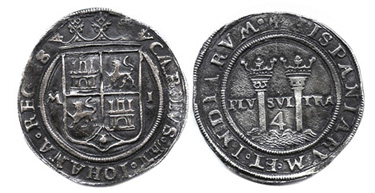
These first coins, struck in
the name of Charles I (1516-1556), better known as Charles V of the Holy Roman
Empire,and
his lunatic mother Juana, are true works of art. Their simple yet thorough
design, which was never used back in the motherland, generally portrays the arms
of Castile (castles) and León (lions), flanked by the mintmark and the initial
of the assayer, who was responsible for the coins’ quality (or atleast
their intrinsic value), on the obverse; the other side bears the symbolic
Pillars of Hercules above waves (except for the wave-less earliest issues), with
the denomination and motto PLVS VLTRA (Latin for “more beyond”) in between.
The legends declare in Latin “Charles and Juana, king and queen of Spain and the
Indies.” Taken as a whole, the symbolism of these first“pillar-type”coins
was practically a battle cry: “There is another land across the ocean, and
it belongs to the King and Queen of Spain!”
Further new mints
constructed at Santo Domingo and later Lima, Peru, which is credited with having
minted the first 8 reales or dollar-sized coin of the New World, imitated the
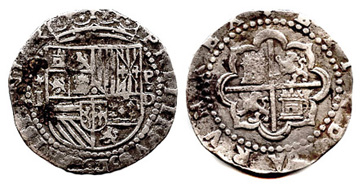
first coinage from Mexico. Not long after his ascension to the throne,
Philip II (1556-1598) changed the design of the coinage (in both Spain and the
Indies) to the“shield-type”design,
which consists of a full Habsburg coat-of-arms on the obverse and a cross with
lions and castles in the quadrants on the reverse. As before, the mintmark
and assayer’s initial flanks the arms on the obverse. (The Mexican silver
coins of this design are always recognizable by the style of their crosses,
which incorporate fleurs-de-lis at the four ends.) While this design was
inuse,
a flourish of new mints began striking: First La Plata (for only a few
months) and then Potosí, Bolivia (where an entire mountain of silver had been
discovered by accident in 1545), followed briefly by Panama City, Panama (a key
transshipment point for the treasures of South America), and then Cartagena and
Bogotá, Colombia. While the silver outputs of the other new mints were
negligible, the Potosí mint churned out many millions of silver coins over the
course of two centuries of continuous minting. Only Mexico came close to
Potosí in silver production, with Lima a distant third.
Gradually during the
shield-type period the quality of the planchets and strike declined. The
hand-struck and hand-cut nature of these coins usually rendered much if not all
of the legend and even some of the interior detail incomplete, eventually
earning these coins the common nickname“cobs.”
Ironically this was also the period in which special, round presentation
specimens known as“royals”began
to be minted (but only sporadically and in very limited quantities). In
the year 1607, the first dates appeared on the coins at Mexico, followed by
Potosí in 1617.
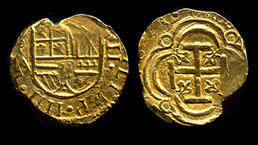
The firstgold
cobsof the Americas were struck
in the year 1622 at the mint of Cartagena (and at Bogotá shortlythereafter),
and they continued the shield-type design with one major difference from the
silver: The cross contains only fleurs-de-lis in the quadrants.
Similar shield-type gold cobs began to be struck in Mexico in 1680. No
gold cobs were ever made at the mints of Panama, La Plata, Potosí, or Santo
Domingo.
Via annual treasure fleets
of overloaded galleons, the silver of the New World was flowing across the globe
at a tremendous rate. Philip II and his successors Philip III (1598-1621)
and Philip IV (1621-1665) were unendingly at war and in debt. The riches
of the New World barely passed through their coffers before heading for such
European banking powers as the Netherlands, whose East India trade soon
deposited the silver of the New World into the hands of Chinese merchants.
In the 1640s, however, the merchants began to notice that the fineness and
weight of the coins being traded were lower than they were supposedto
be. In the face of losing the universal acceptance of their beloved New
World currency, the Spanish monarchy launched a massive investigation that
uncovered several decades of fraud and abuse at the Potosí mint. At least
one assayer and even the mayor of Potosí were put to death. The suspect
coinage was recalled and either melted or devalued, depending on its intrinsic
quality, and new coins were marked with special countermarks to distinguish themfrom
their devalued predecessors. Eventually a completely new design was
implemented and refined through several varieties (known as“transitionals”)
in 1652 that bore slight resemblance to the original design of the first
pillar-type coinage of Mexico.
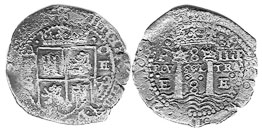
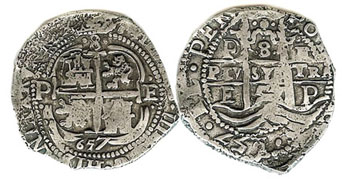
This new design, commonly
referred to as“pillars-and-waves”and
unique to New World coinage, incorporates several iterations of the most
important elements that seemed to be absent on many of the earlier shield-type
coinage: date,
assayer, mintmark, and denomination. The obverse of these new coins
displays a new cross-lions-castles, much like the earlier reverse, but with bars
at the ends of the cross (“Jerusalem” cross) and with the denomination at top,
mintmark at left, assayer at right, and date below. The reverse, from
which the name is derived, bears the Pillars of Hercules above a series of waves
with PLVS VLTRA across the middle, but also with mintmark-denomination-assayer
across the top and assayer-date-mintmark across the bottom. (Curiously the
waves on coins from Potosí, high in themountains,
always bow up the middle, whereas the waves on coins from Lima, down by the sea,
always bow slightly down in the middle.) The reverse legend contains the
name of the mint and a third date. With so much repetition it was believed
these coins would satisfy all the requirements of accountability that would doom
any future assayer who tried to get away withfraud.
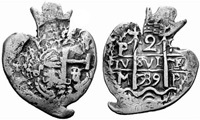
Emphasizing the rustic beauty of this new design was a new series of specially
heart- or pomegranate-shaped coins struck from presentation “royal” dies at the
Potosí mint, and these so-called“hearts”are
among the most prized and valuable coins of Spanish-American numismatics.
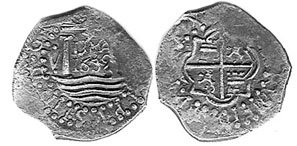
Also rare and valuable are the 1659-60 emissions of the Lima mint, which had
resumed operation under the orders of the Viceroy of Peru (but not the king).
These special pillars-and-waves coins are known as“Star
of Lima”coinage due to the
prominent star (Lima’s distinctive symbol) in the design. For whatever
reason, all Mexican cobs and the gold cobs of Colombia were not subject to the
new requirements and continued with the shield-type design. As a result, a
new series of Peruvian goldcobs from
Lima (starting in 1696) andCuzco
(1698 only) were effectively the only pillars-and-waves type gold coins issued
(the Star of Lima gold cobs of 1659-60 are represented by just two 8-escudos
specimens, one of each date, which probably never circulated).
The simple beauty of the
Bolivian “hearts” and Peruvian gold cobs stood in contrast to the nadir of the
Spanish monarchy. Charles II (1665-1700), who at age 4 came to the throne
upon the death of his father Philip IV, was weak and deformed, the product of
several generations of inbreeding within the Habsburg dynasty. Unable to
produce an heir, Charles II willed his monarchy to a grandson of the French King
Louis XIV, touching off several years of war within Europe. The new king,
Philip V (1700-1746), was the first Bourbon king of Spain, and his coinage is
easilydistinguished from prior
coinage by the inclusion of three fleurs-de-lis in the center of the arms.
Although Philip V abdicated in favor of his son Louis I in 1724, the new king
died in that same year and Philip V returned to the throne. New World cobs
with the name of Louis I in the legend are generally rare, even though the mint
of Potosí struck them for three years (1725-7).
Generally, as time wore on,
the execution of design of all cobs deteriorated, to the extent that some of the
silver cobs being minted were merely lumps of very uneven thickness, or
odd-shaped slabs with weak detail. While quiteexpedient,
cobs were simply becoming unacceptable for modern commerce. In 1732 a new
design began in Mexico,and with it a
new concept: “milled,” or machine-struck coinage. Each milled coin
was to have fully readable details on round planchets with embellished edges
that could not be cut away without detection. This was the era of the
silver“pillar dollar”and
its fractions, and in gold the first New World coins to bear a portrait of the
king.
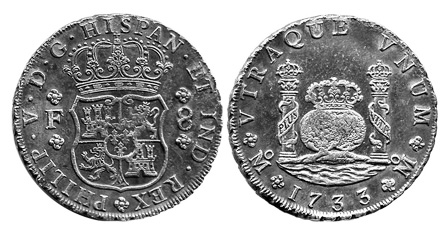
The pillar dollar, perhaps
the most popular and arguably the most beautiful of all Spanish colonial
coinage, is reminiscent of the pillars-and-waves cobs in that it bears pillars
above waves on the reverse. Between the pillars, however, are two globes,
representing the Old World and the New World, with the motto VTRAQUE VNUM (“and
we are one”) in the legend. The reverse, as on the cobs, bears the arms of
Castile and León, but this time in a crowned shield. The pillar dollar was
unique to the Spanish colonies but gained worldwide acceptance—a true “trade
dollar” that was even legal tender in the early United States until 1857.
Three new mints began
operation in the pillar-dollar era: Guatemala City, Guatemala; Santiago,
Chile; and Popayán,Colombia.
Guatemala, however, apparently had the pillar-dollar dies (and bust-type dies in
the gold) but not the apparatus, as the Guatemala issues from 1733-53 were all
handmade and crude, and therefore are considered cobs. The pillar dollars
of Santiago are extremely rare, and those of Popayán are probably fictional.
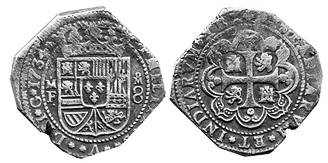
Also made at Mexico during the beginning of the pillar-dollar period was a
two-year series (1733-4) of transitional 8 and 4 reales known as“klippes,”as
they were machine-struck with the shield-type cob design but cut to proper
weight by hand, usually resulting in squarish shapes. Not all the mints
changed over to pillar dollars at once, and in fact the Potosí mint continued
striking cobs until 1773, even after a replacement for pillar dollars had been
chosen!
Replacing the silver pillar
dollar in 1772, in an effort to sneak in a reduction in fineness to alleviate
Spain’s mountingfinancial
chaos, was the“bust-type”or“portrait”
dollar, which displays a right-facing bust or portrait of the king with date
below on the obverse. The reverse is very similar to the old pillar-dollar
obverse except that pillars were added outside the shield.
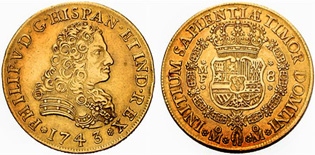
The bust design had already
been in use for gold coinage beginning in Mexico in 1732, under Philip V at
first and then Ferdinand VI (1746-1759). The bust-gold reverse does not
bear pillars but instead (in the 8 escudos at least) displays the chain of the
Order of the Golden Fleece. The reverse legend, originally INITIUM
SAPIENTIAE TIMOR DOMINI (“the beginning of wisdom is the fear of the Lord”), was
changed under Ferdinand VI to NOMINA MAGNA SEQUOR (“I succeed great names”) and
then finally to IN UTROQ FELIX AUSPICE DEO (“each happy in its own place with
God’s guidance”) under Charles III (1759-1788) and his successors.
At each of the New World
mints, a popular curiosity resulted from the fact that the motherland was a
whole ocean away: the use of the old king’s bust under the new king’s name
for the first few years of his reign, at least until some kind of portrait of
the new king was available to the local die-engraver. Interestingly the
gold coins from the mint of Santiago show the portrait of Charles III all
throughout Charles IV’s reign (1788-1808), and then the portrait of Charles IV
all throughout Ferdinand VII’s reign!
Santiago’s “error” bespoke
the troubles back in Spain, where Charles IV abdicated under pressure from
Napoleon, who soon replaced the Spanish successor Ferdinand VII (1808-1833) with
Napoleon’s brother Joseph. By the time Ferdinand had regained the throne
in 1814, the movement for independence in the Americas had begun, and within
eleven years all the former Spanish American colonies except Cuba and Puerto
Rico (which had not struck any coins anyway, save for a Cuban siege token in
1741) would become independent republics. Throughout the reign of
Ferdinand VII, however, and even during the various local wars for independence,
each of the colonial mints produced coins with the portrait and name of the
Spanish king. A blossoming of provisional mints opened in Mexico, which
heretofore was represented only by the Mexico City mint, and the ancient Inca
capital of Cuzco in Peru began striking anew in 1824. One year later, in
1825, the very last Spanish coins of the Americas were struck at Potosí, up in
the mountains, where the tide of independence had finally risen to close the
chapter on nearly three centuries of Spanish rule in South America.
-
This article has been first published in Standard Catalog of World Coins Spain,
Portugal and the New World: Spain, Portugal, and the New World Publisher: kp
books; 1 edition (January 15, 2002) written by Daniel Frank Sedwick.
Note: Various Mexican
provisional mints (Chihuahua, Durango, Zacatecas, Guadalajara, and Guanajuato
were the main ones) began striking under Spanish colonial control around 1810,
but in this catalog these issues are included under a special section within
Mexico entitled “War of Independence.”
[1]Including
transitionalklippes(8
and 4 reales only) 1733-4.
[2]Special“Star
of Lima”coinage (silver
and gold).