Judgment of the relative worth
of a gold or silver cob, within the market range of its category at any given
time, should reflect a composite evaluation of these factors:
1. What is
the mint?
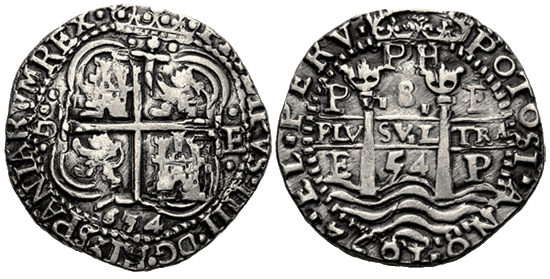
2. Is the
mintmark visible, and how clearly so? How many indications of mintmark
are visible? (Up to three are possible on silver cobs of the
pillars-and-waves type.)
3. Is
the full date visible? In the case of a partial date, the final one or
two digits are more important than the first one or two digits. Or is
the cob of a period when cobs were not dated, hence the absence of a date is
no factor?
4. If
dated, how many dates are visible, and how clearly so? (Two or three
dates are possible on some cobs, only one possible on others.)
5. Is
the assayer’s initial visible, and how clearly so? How many
repetitions of the assayer’s initial are visible? (Up to three are
possible on silver cobs of the pillars-and-waves type.)
6. Is the
legend readable? Completely so? Partially so? Not at all?
(The king’s name and ordinal are the most desirable part of the wording to
be visible.)
7. Is the
denomination visible, and how clearly so? (A second indication of
denomination is possible on silver cobs of the pillars-and-waves type.)
8. How
complete and clear are the elements of design and other details? For
example, what percentage of the shield, crown, and cross is visible?
How nice, or poor, are the lions and castles?
9. Are
the design and details well centered, and on both sides or on only one side?
If not well centered, as is usually the case, what is gained and what is
lost in the expansion of some peripheral details and the resultant reduction
of others?
10. Is the
strike bold, average, or weak? Neatly struck or double struck?
11. Is the
cut of the metal of a shape typical for its period and mint or in some way
more, or less, attractive or interesting? (Cracks in the edge, while
natural, lower a cob’s value, although smaller splits are less detrimental.)
12. How
closely does the weight of the coin approximate its original stipulated
weight? Has the coin lost weight from shaving, slinging, or immersion
in the sea?
13. Has the
coin been unnecessarily cleaned or polished? (Cleaning is necessary
for silver cobs from sea salvage or land burial, undesirable otherwise.)
14. Has the
coin been holed? Plugged? Removed from jewelry? Mutilated
in any other way? (Holes in silver cobs are frequent, so not as
damaging to their value as in the case of machine-made coins, but a cob
without a hole is still much preferable to the holed piece.)
15. What is
the overall condition or grade by normal numismatic standards? (Very
few cobs are seen in Uncirculated grade, or even in About Uncirculated.)
16. Entirely
a subjective judgment, how attractive is the overall appearance of the coin
(“eye appeal”)? Does the coin appeal to you?
17. How many
coins of this type—such as mint, assayer, date, specific shipwreck or
sea-salvage—have been on the market lately? (Sometimes a hoard of
similar coins is discovered, and what used to be rare can become less rare.)
18. Are you
sure the coin is genuine? (Its purchase or trade from a cob
specialist—be he dealer or advanced collector—is the best guarantee, until
you yourself are sufficiently experienced to make the judgment with
confidence.)
The few coins that do not fit
into the prevailing price ranges are the particularly awful specimens (greatly
underweight, very poor details, badly corroded, or mutilated), which will be
lower, and the extraordinarily nice ones (singular detail and beauty), which can
be higher.
Like all commodities, the overall foreign or domestic coin market oscillates
between strength and weakness at a given time. This can be affected by
general economic conditions (rare coins are purchased with discretionary
income), or by fad (silver dollars can be hot one month, commemorative half
dollars the next; or British coins are in demand one year, Spanish coins the
next), or by a temporary and usually accidental surfeit or shortage of certain
types of coins. For example, in the 1983-85 period a huge hoard of gold
cobs of the 1715 fleet appeared on the market and depressed prices. After
the material was absorbed, prices rebounded and today are many times their
former levels. The test of a coin worth holding is the ability of its
price to recuperate from any temporary depressant. Buy the best and the
rarest and in the long run you will be safe.
-Reproduction of the articles in whole or part is strictly prohibited without
written permission of the author/s.
Daniel Frank Sedwick, LLC
P.O. BOX 1964 | Winter Park, Florida 32790
Phone: 407.975.3325 | Fax: 407.975.3327
We welcome your order,
want lists, comments, material for sale or consignment and suggestions.