GOLD AND SILVER INGOTS FROM SHIPWRECKS
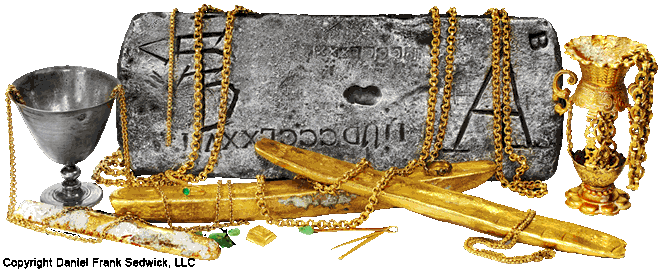
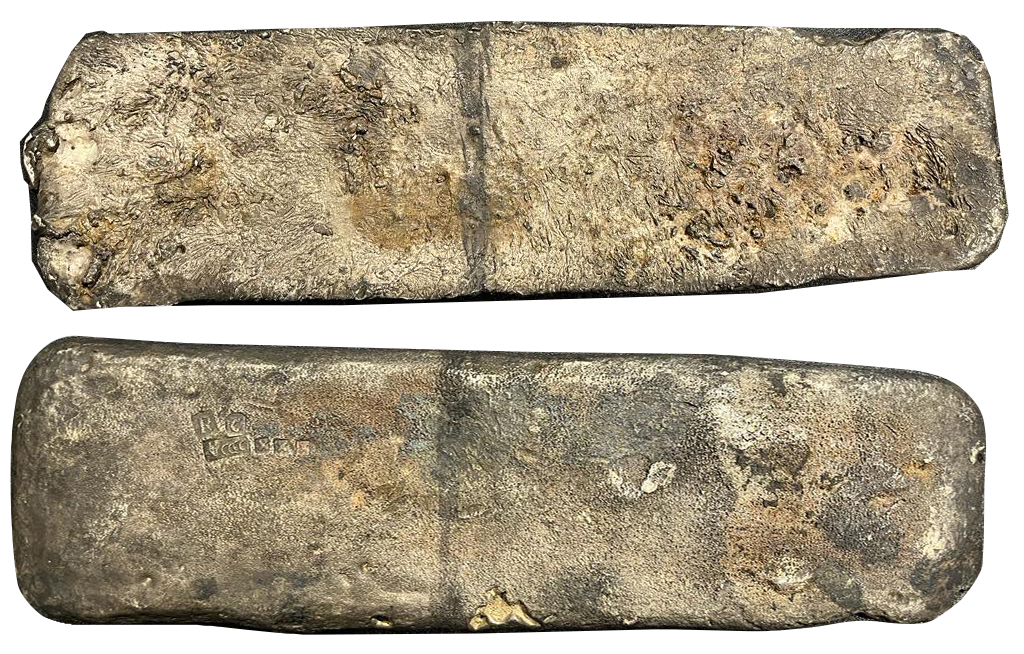
These ingots do not exist in great quantities—typically any given shipwreck will yield all known specimens of a given style of ingot, and with the exception of the hundreds of monstrous (80-lb.) loaf-shaped bricks of silver from the Atocha, I have never heard of more than about 200 similar ingots found at once. Compare that to coin rarities, and you will quickly realize that ingots are much rarer than contemporaneous coins, and of course they are almost always more impressive.
PLEASE LET ME KNOW IF YOU HAVE SHIPWRECK INGOTS FOR SALE! I particularly need (never thought I’d say this) the 80-pound silver beasts from the Atocha, especially Class Factor 1.0, for which I am now paying triple what I did just five years ago!
|
Item # (click to see photo) |
First listing date |
ITEM DESCRIPTION |
PRICE |
GOLD INGOTS
From the “Golden Fleece wreck,” an unidentified Spanish ship sunk ca. 1550 in the northern Caribbean:
I have sold quite a few ingots (silver and gold) from this wreck, whose nickname comes from the elegant stamping found on a few of the cut pieces of larger gold ingots (although unfortunately I have sold out of those pieces, and no more are forthcoming). The wreck is still unidentified, its exact location undisclosed (to protect future salvage), but the items it has yielded, being among the first gold and silver to come from the New World, are too rare and historically important to be overlooked for their nebulous salvage origin. The varying purities of these bars are reminiscent of the "tumbaga" gold bars of the 1520s that were sold in the 1990s. I believe these "Golden Fleece wreck" bars are the only known examples made in the colonies between the "tumbaga" period of the 1520s and the specimens found on the 1554 Fleet at Padre Island, Texas.
| 040604132001 |
February, 2008 | Complete "finger" bar #39, 1110 grams, 17K. A very impressive, full bar (not cut on either end), about 10" long, 1" wide and ¾" thick, marked with fineness XVII five times and heavily impregnated with white coral in the middle, very bright yellow color and neatly cast, a true treasure in every sense! | Call or email for price |
|
010604130002 |
February, 2008 | Cut "finger" bar #42, 516 grams, 19½K. Curious bar with lots of red coloration all over and loaded with coral on marked side (hence fineness markings unclear, but appear to be XIX•• three times), crudely cut at one end (also covered with coral), about 6½" x 7/8" x ½". | Call or email for price |
From the 1715 Fleet, east coast of Florida:
030805180001![]() |
April, 2008 | Huge, oval ingot, 59.32 ounces, probably 22K, found by Dave Luke and company in the 1980s in the Corrigan's area (believed to be the Regla). This is a lovely piece of history, measuring about 5-3/4" x 2½" x 3/4", with only one marking: 4o3 in elegant Spanish numbers (punched directly onto the bar). No tax stamps, no foundry marks, no fineness (unless that is what "4o3" means), so possibly contraband, but then why is it marked at all? This was sold to the current owner by my father in the 1980s, and he had evidence that it came from Peru, but I have no way to prove that now. The surfaces are mostly smooth, with neatly rounded edges and bottom, but mainly it is just a big hunk of gold that is worth about $50,000 just for melt! |
SILVER INGOTS
From the “Golden Fleece wreck,” an unidentified Spanish ship sunk ca. 1550 in the northern Caribbean:
See note above for gold ingots from this wreck. Popularly known as “splashes,” the crude silver ingots from this source were made by simply pouring molten silver onto the ground, which created a thin, usually roundish puddle that, when cool, could be easily picked up and tossed into a pile for carting off. The markings (when visible) on these ingots consist of only two figures: a fineness in Roman numerals expressed in parts per 2400 (just like our modern-day "karat" system) and a tax stamp comprised of a crown above the letter C for Charles I within a border of dots.
010804130040![]() |
February, 2008 | Large, round, thin splash "P", 2988 grams, with two clear fineness markings IIU CCC X L (2340/2400 = 97.% fine) but no visible tax stamps (one could be lurking under a patch of coral still attached to the surface), two "mountains" of extra silver on surface, with big part of edge rolled up (probably due to the weight of other ingots and the confines of the chest it was in), approximately 10" in diameter, lots of gray and gold color (not over-cleaned like some earlier offerings). | $3,750 |
From an unidentified ca.-1554 wreck off Santo Domingo, Dominican Republic:
050816011042![]() |
Small, whole disc, 9.35 troy oz., with one full tax stamp (pillars and PLVS VLTRA, somewhat visible, in a circular mark), best specimen seen so far from this wreck (the stamp identical to those found on Padre Island ingots), the stamped side fairly smooth (one small void in center, darkly toned) but the other side with countless craters (looks like the surface of the moon) that were probably not corrosion but were bubbles from the casting process. | $2,950 | |
050816011047![]() |
Very small, whole disc, 4.88 troy oz., with full but weak tax stamp, a very neat and pretty ingot with circular tax stamp (probably the same as on the ingot above but totally illegible), both sides fairly smooth, lightly toned, a cute little piece that may have served as a form of money (so-called plata corriente). | $975 | |
050816011043![]() |
Small, oval disc, 12.85 troy oz., with one very weak circular tax stamp, very interesting texture (a bit crystalline, with lots of stress cracks and flow lines), lightly brown-toned. | $795 | |
| Irregular cut piece, 10.96 troy oz., no visible markings, about half of a thin "splash" ingot, with lots of bubbles on one side and flow lines on the other, also with a spot of white coral near the edge, all nicely toned. | $695 | ||
050816011044![]() |
Very irregular cut piece, 5.73 troy oz., no visible markings, very crude, sort of a triangular cut from a thin "splash," rough texture from oxidation, toned but also with some "white" silver exposed. | $595 |
From the Rooswijk, sunk in 1739 southeast of England:
| 040801101008
|
Large silver bar, 1967 grams (63.25 troy oz.), with A, VOC, and "billy goat" stamps on one side, choice specimen. While several hundred of these ingots were found on this wreck, very few have entered the market, and of those, this is arguably the most beautiful, as its markings are crisp and clear as day, with even the grass beneath the billy goat's hooves in evidence... so nice, in fact, that it was chosen for a prominent photo in Ernie Richards' new book SHIPWRECKS and Their Coins: Volume 4—The 1740 Dutch East Indiaman "ROOSWIJK", a free copy of which will accompany this piece. The big A on the bar stands for Amsterdam (the chamber of the Dutch East India Co. to whom this ingot belonged), and of course the VOC stands for "Vereenigde Oostindische Compagnie" (Dutch East India Co.); the "billy goat" is an as-yet unidentified assayer or foundry mark. The fineness of this bar is probably somewhere in the range of 97.9%-98.8% pure (based on tests by Christie's Amsterdam on similar ingots from the Bredenhof of 1753), so it is worth over a thousand dollars for its melt value alone. Similar specimens brought as much $4,150 each in auctions (back before the big rise in melt value). Very neatly cast to a size of roughly 6" x 1½" x 1" (with one end typically dimpled and cut), this ingot is the perfect size for a paperweight or just a nice little shelf display. |